



A scientific committee will prepare a work plan with a calendar and budget on lindane in a few months
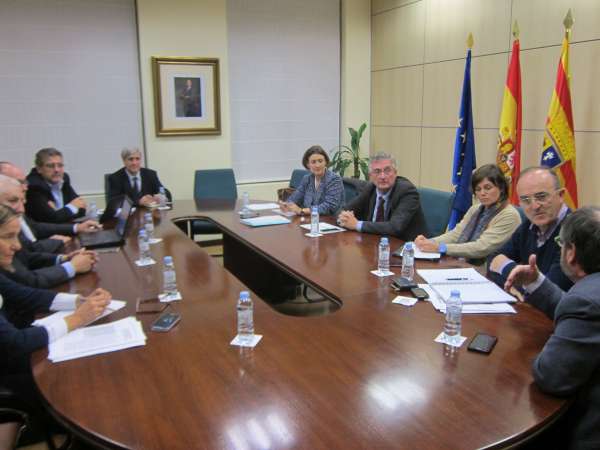
A scientific committee, made up of experts from different areas, will prepare a work plan with a calendar and budget to address the problem of decontamination by lindane generated by the company Inquinosa in the town of Sabiñánigo in Huesca and after the produced a spill into the Gállego river from the Bailín landfill, where the remains of this pesticide were deposited.
The Minister of Rural Development and Sustainability of the Government of Aragon, Joaquín Olona, chaired the meeting to establish this scientific committee to "address a problem that we have under control, but not resolved, and that will require a major effort, not only economic and financial, but also scientific and technical innovation, and that is why this committee of experts has been established," he explained.
Olona expressed her gratitude for the "great generosity they have shown in advising the Government of Aragon independently, because it is a great responsibility in the face of a complex problem."
Speaking to the media, Olona acknowledged that the scientific committee's work plan "will be binding," adding that "we will abide by their scientific and technical opinion, validating what has been done so far, and we do not rule out the need for some corrections."
The Government of Aragon will provide them with information so they can develop a more intensive work program defining the methodology to be followed, and the Regional Ministry has also expressed its "social concerns about the safe drinking water."
Olona noted that the work plan entrusted to the scientific committee also responds to the mandate of the Parliament of Aragon, which has urged the regional government to develop a work plan with a timeline and budget, and that "it is a great challenge and will be the committee's main task."
Two more committees
He graphically explained that "absolutely everything is in the hands of this committee for their consideration, so they can confirm whether what has been done is correct, and we don't impose conditions on them. Instead, they can evaluate without limitation and not convince ourselves that we have done everything right." In this regard, he added that "they were established to listen to them and will be the ones to set the scientific and technical guidelines."
The next meeting of these experts will possibly take place in Sabiñánigo so that they know first-hand the problem, in addition an institutional committee will also be created between the Government of Aragon, the Ebro Hydrographic Confederation (CHE), the local administrations and the Irrigation Community from Alto Aragón; and a third social committee will accommodate organizations that have been working for a long time and have helped to identify this problem.
"With the three working committees, we aim to provide them with the necessary documentation with a commitment to transparency because the goal is to make information available to society," Olona emphasized.
Thousands of tons
The minister emphasized that "my concern is not the budget, but rather defining the work plan rigorously and on a solid scientific and technical basis," arguing that "we don't know how much it is, but we know it's of such magnitude that it's unmanageable for the DGA, and that's one reason we need to have a solid plan to then go to the European institutions to ask for help, but with a work plan that allows us to convey that we know what we want to do and that we're not going to waste resources."
Regarding the water supply to riverside towns in the eastern Cinco Villas, he noted that actions such as the installation of carbon filters have been carried out, and "we are looking for simple solutions such as alternative sources that are not contaminated, which will have to be implemented in the event of a potential pollution spike. These solutions are not definitive, but rather for emergencies, and the town councils are aware of this."
Olona stressed that the dismantling of the Inquinosa facilities "is one of the most immediate actions and has the full agreement of all stakeholders, but the question is what we do with the product and how we treat it," noting that the problem reaches the ground of the facilities themselves "with a river terrace that we would have to remove, and the depth needs to be determined."
He also noted that it is located in an area within the Sabiñánigo area and "will require very cautious measures to prevent any emissions from affecting the population," as it involves thousands of tons of contaminated soil.
Olona has indicated that one of the options would be to take the waste to the safe cell of the Bailín landfill, but it will be submitted to the opinion of the scientific committee to see if they consider it correct.
MEMBERS
For the formation of the scientific advisory committee on lindane, a multidisciplinary team made up of prestigious specialists in the field of research and the university environment has been selected.
In this way, the committee is made up of seven researchers and professors from within and outside our community, such as the professor of Animal Health at the University of Zaragoza, Juan José Badiola; the CSIC Research professor at the Aula Dei Experimental Station, Enrique Playán; the professor of Organic Chemistry at the University of Zaragoza, José Antonio Mayoral; the professor of Hydrogeology at the University of La Coruña, Javier Samper; the professor of Soil Science at the University of Santiago de Compostela, Felipe Macías; the professor of Chemical Engineering at the Complutense University of Madrid, Aurora Santos; and the Scientific Director from the Biosanitary Research Institute of Granada, Nicolás Olea.


