



Researchers at the ibs.GRANADA develop a new method for 3D tissue bioprinting that will accelerate implantation in clinical practice
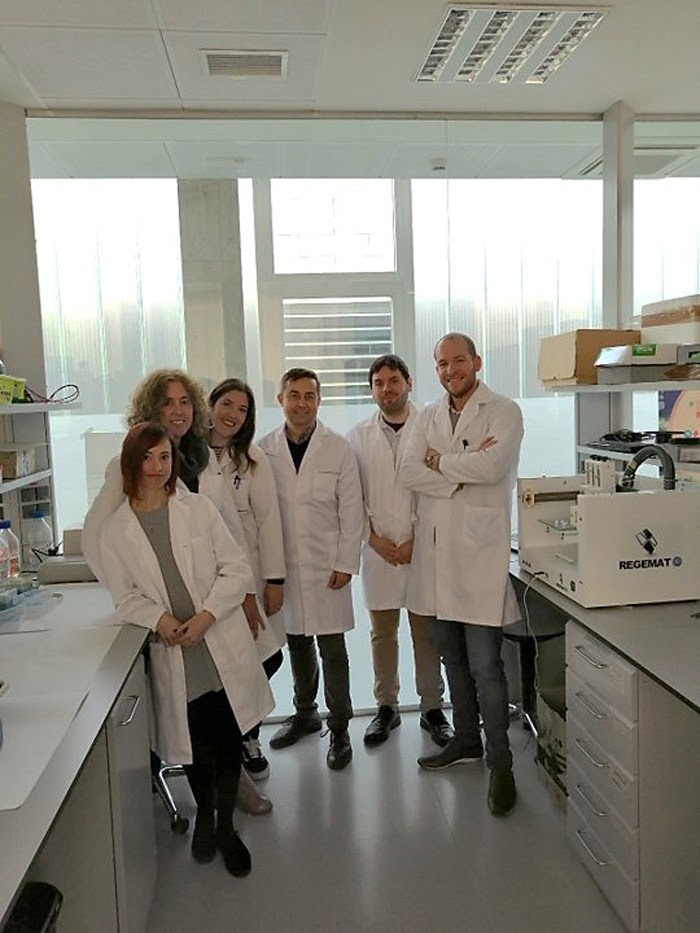
The research group «B-16 on Advanced Therapies: Differentiation, Regeneration and Cancer» of the ibs.GRANADA and the UGR, together with the Granada company REGEMAT 3D, has published a new printing process called «VbV» (from the English Volume-by-
Simultaneous 3D bioprinting of materials and cells has emerged in recent years as a new technology to create living tissues that regenerate lesions and organs or that simulate tumor environments. Biocompatible materials that currently exist for 3D bioprinting have a wide melting temperature range for printing, each with its advantages and disadvantages. Biomaterials that melt at low temperatures allow the printing of cells that maintain greater viability, but tend to have low mechanical and biodegradable behavior. However, the vast majority of thermoplastic polymers with optimal mechanical properties for applications in cartilage regeneration approved for clinical use, melt at high temperatures, so that cell viability decreases in a normal bioprinting process called FDM (molten deposition). .
Furthermore, the geometric constraints of bioprinting when using thermoplastic polymers that melt at high temperatures are based on the fact that, to avoid cell damage due to temperature, the zigzag meshes are printed in such a way that the cells are positioned in the interspaces and the next layer is built on and supported by the thermoplastic from the previous layer. Although this geometry avoids the contact of the cells with the newly printed thermoplastic, it presents restrictions to the final properties of the scaffold. («scaffold») and limits the internal contact area for cell adhesion.
In this study, published in the journal Experimental Biology and Medicine, through the «VbV» bioprinting configuration process, the scaffold is generated with the desired geometry and characteristics and then the cells are introduced into the required areas, allowing total flexibility in the choice of the polymer used, the geometry of the scaffold and the cell distribution. The joint bioprinting of a polylactic acid (PLA) scaffold and chondrocytes has shown that this procedure prevents cell damage, abolishing the induction of death (apoptosis) in cells subjected to the bioprinting process, and these cells are able to proliferate and colonize the entire scaffold. Furthermore, a final biological construct is obtained without the geometric restrictions that can compromise tissue performance, which provides great advantages when working on the regeneration of tissues that support large loads, such as articular cartilage.
This method has solved the main complications of common 3D bioprinting techniques: i) it can be used with already clinically approved biomaterials that melt at high temperatures, such as polylactic acid (PLA) and polycaprolactone (PCL), ii) it has no restrictions on geometries that could limit the clinical application of 3D lip printing in cartilage, iii) cells can be bioprinted together without affecting their viability. The method has been validated for application to cartilage lesions, but it is easily transferable to other types of tissues or even in 3D bioprinting of tumor models. Therefore, the use of this 3D "VbV" biofabrication process could accelerate the clinical application of bioprinting technology.
REGEMAT 3D (www.regemat3d.com), a technology-based company based in Granada, is leading the development of 3D bioprinting technologies and has users in more than 20 countries, working on different applications and tissues. The company has been working for years with the research group: "Advanced Therapies; Differentiation, Regeneration, and Cancer," led by Professor Juan Antonio Marchal Corrales. Both participate in a joint project to develop new therapies for cartilage regeneration. The company's collaborators include the Tissue Engineering and 3D Printing Platform (PITI3D) of the La Paz University Hospital in Madrid, the Traumatology Department of the San Cecilio Hospital in Granada, and the Virgen del Rocío Hospital in Seville. In this way, they are working to ensure that the results do not remain solely in the laboratory but can be translated into society so that new technologies reach patients.
Researchers from the universities of Granada and Jaén belonging to the Unit of Excellence have participated in this work. «Modeling Nature: from nano to macro» from the UGR, the Biosanitary Research Institute of Granada (ibs Granada) and the Center for Biomedical Research (CIBM). In addition, researchers from the REGEMAT 3D companies (Jose Manuel Baena, CEO), and Bioibérica SAU (Patricia Galvez, responsible for the area of Advanced Therapies), and has been funded by the Ministry of Economy, Innovation and Science (Junta de Andalucía, Project of Excellence CTS-6568) and the Ministry of Economy, Industry and Competitiveness (FEDER Funds, RTC-2016 -5451-1)
Bibliographic reference:
Baena JM, Jiménez G, López-Ruiz E, Antich C, Griñán-Lisón C, Perán M, Gálvez-Martín P, Marchal JA Volume-by-volume bioprinting of chondrocytes-alginate bioinks in high temperature thermoplastic scaffolds for cartilage regeneration. Exp Biol Med (Maywood). 2019 Jan; 244 (1): 13-21. doi: 10.1177 / 1535370218821128. Epub 2019 Jan 10.


