



The ibs.GRANADA joins once again the great showcase of research and dissemination at the 'European Researchers' Night'
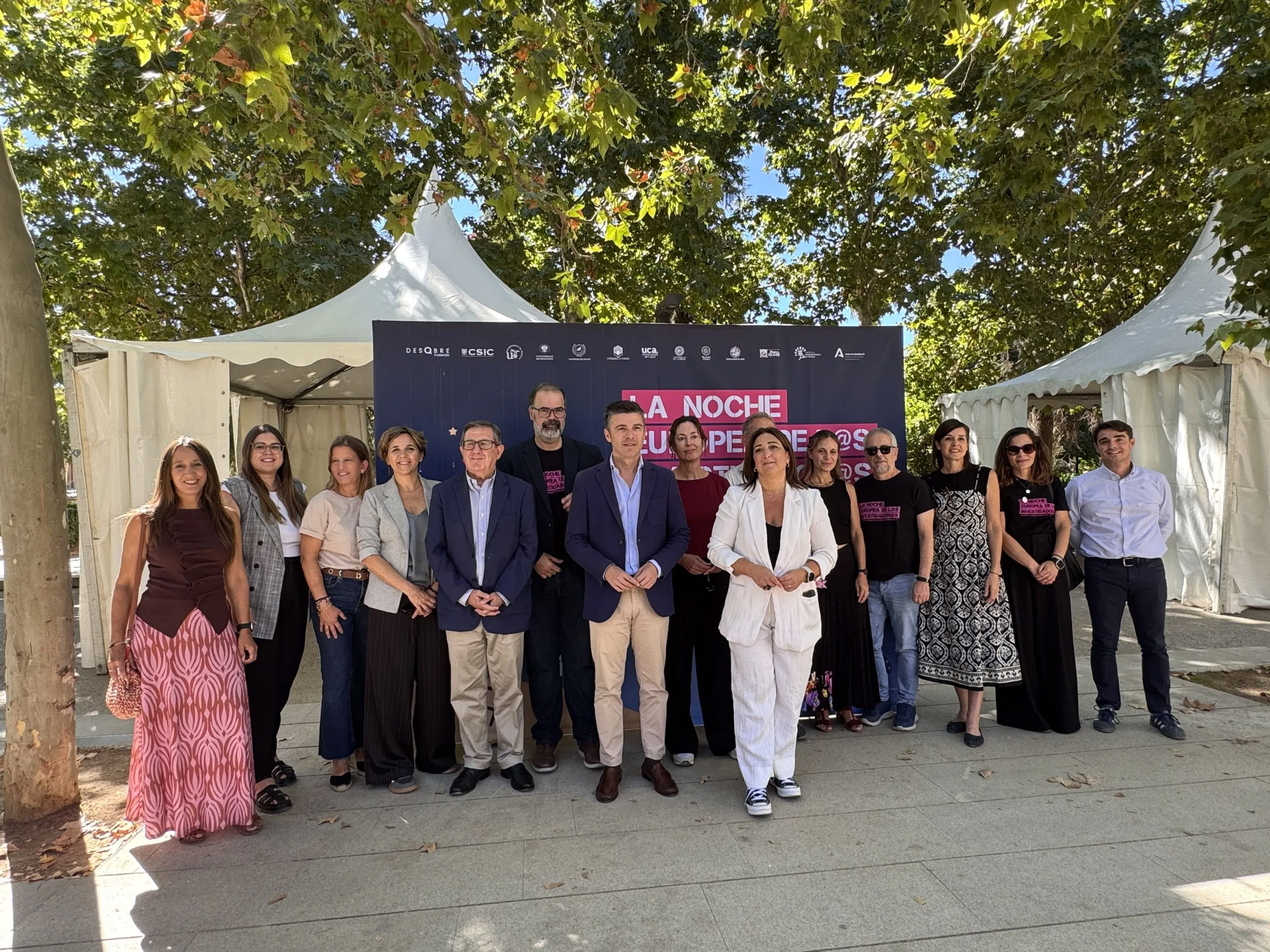
More than 700 researchers will participate this Friday night in 300 activities in Granada, Ceuta and Melilla, with a wide program aimed at the more than 5.000 expected attendees.
The Granada Institute for Biomedical Research (ibs.GRANADA) is participating once again in The European Night of Researchersibs.GRANADA, one of Europe's leading science outreach events, reaffirms its commitment to bringing biomedical research closer to society. Researchers from the Institute will share their work with the public through various outreach activities, demonstrating in an accessible way how health research generates knowledge and can contribute to improving prevention, diagnosis, and healthcare. ibs.GRANADA is thus once again joining this European initiative, which brings together thousands of people each year around science, innovation, and knowledge. Check out the full ibs.GRANADA program here.
Once again, the Paseo del Salón in Granada hosts The European Night of ResearchersOne of Europe's leading science outreach events, the conference will once again become a major showcase for research and innovation. This year's edition, taking place on the evening of Friday, September 25, will bring together more than 700 researchers from various institutions, who will participate in 300 activities in Granada, Ceuta, and Melilla.
The European Night of Researchers The 2026 event features the participation of the University of Granada, the group of CSIC centers in the province: the Zaidín Experimental Station (EEZ-CSIC), the Institute of Astrophysics of Andalusia (IAA-CSIC), the López-Neyra Institute of Parasitology and Biomedicine (IPBLN-CSIC), the School of Arabic Studies (EEA-CSIC), the Geological and Mining Institute of Spain (IGME), the Andalusian Institute of Earth Sciences (IACT); also the Science Park Consortium, the ibs.GRANADA Biosanitary Research Institute, the Archaeological and Ethnological Museum of Granada, the PTS Foundation, the Descubre Foundation and the Granada City Council, in addition to other collaborating entities and organizations that join this scientific outreach initiative to bring research and knowledge closer to the public.
In Granada, this year's event features 33 themed areas distributed along the Paseo del Salón, including 27 stands from scientific, university and educational institutions, and five spaces Kids Corner dedicated to children and a Senior CornerIn these spaces, through workshops, experiments, demonstrations, and participatory activities, science and knowledge will reach audiences of all ages.
During the presentation of the event, Marga Sánchez Romero, Vice-Rector for University Extension, Heritage, and Institutional Relations and Director of the Scientific Culture Unit at the University of Granada (UGR), highlighted the strong institutional support the initiative is receiving, noting that “all research institutions, all political institutions, are all supporting this celebration of science.” The Vice-Rector also emphasized the transformative value of knowledge contributed from all disciplines, stating that “science is the best way to solve the world’s problems” that we currently face.
The Councillor for Culture of the Granada City Council, Jorge Saavedra, has emphasized that La European Researchers' Night It exemplifies the city model that Granada aims to project in its bid to become European Capital of Culture 2031. “Culture and knowledge are a combination that can only bring future opportunities to Granada,” he stated. Saavedra also highlighted the collaboration between government bodies, universities, research centers, and entities such as the CSIC (Spanish National Research Council), the Descubre Foundation, and the Health Technology Park to bring science closer to the public in an open, European space. He also expressed his gratitude to the organizers for the continued growth of an initiative now in its fourteenth edition and invited residents and visitors to participate in the activities scheduled along the Paseo del Salón.
For her part, Julia Gutiérrez Pastor, head of the Scientific Outreach Committee of the Geological and Mining Institute of Spain, pointed out that La European Researchers' Night It is an exceptional opportunity to share science in an accessible, participatory, and creative way. According to Gutiérrez, the CSIC centers have prepared numerous activities for the public to experience and discover different areas of knowledge, from earthquakes and glaciers to genetics, eclipses, and manuscript reconstruction. Gutiérrez emphasized that the six participating CSIC institutions are joining forces to bring research closer to society and reaffirmed the responsibility of public centers in disseminating knowledge. He also expressed his gratitude for the collaboration of all the entities involved in organizing the event.
New for this edition is a Senior CornerA space specifically designed to bring research closer to a senior audience. It will address issues related to artificial intelligence, health, active aging, technology, sports, nutrition, and memory, and will include some intergenerational activities.


